
December 15 / 2025 / Reading Time: 3 minutes
Better data, better protection: Our recommendations at the Council of Europe
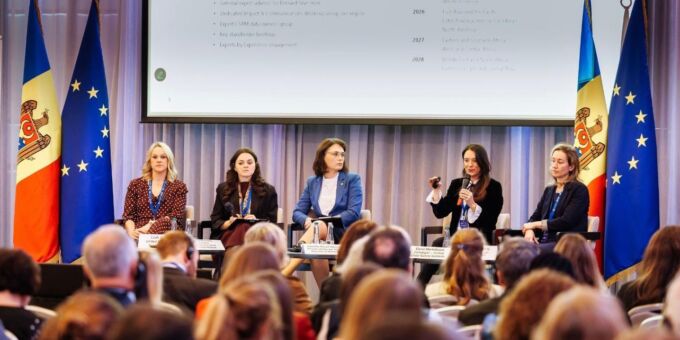
Child sexual exploitation and abuse (CSEA) is a global challenge that demands strong evidence and coordinated action across countries. On 18 November, the Day for the Protection of Children against CSEA, we presented Childlight’s CSEA data from the 2025 Into the Light Index on Global CSEA at a high-level Council of Europe conference in Chisinau, Moldova. Policymakers, experts, practitioners and members of the Lanzarote Committee gathered to discuss one key question: How can better data strengthen the protection of children across Europe?
The conference, organised by the Children’s Rights Division of the Council of Europe, followed the recent Implementation Report by the Committee of Parties to the Lanzarote Convention on CSEA data collection and use. Participants joined thematic discussions and workshops covering different aspects of CSEA data and how it can inform policy across European countries.
During a panel on evidence-based policy, we presented new data on the scale and nature of CSEA from our Into the Light Index. We highlighted three priority areas where CSEA data needs urgent strengthening:
- Maximising the value of public sector data: This means including police-recorded cases of CSEA as a distinct category in official crime statistics to enhance visibility and monitoring. It also involves recording CSEA cases detected through education, health and other public services, and considering publishing these statistics. Importantly, we need to improve the quality and transparency of public sector data so that its limitations are clearly understood and communicated.
- Strengthening hotlines to report online child sexual abuse material: Hotlines play a critical role in identifying and removing harmful content, and their data supports monitoring emerging trends in online CSEA.
- Supporting regular population-based surveys: Surveys conducted regularly, such as every 5-10 years, provide essential prevalence estimates. This is especially the case for technology-facilitated CSEA, where data remains sparse.
These three priorities align closely with the findings of the 2025 Implementation Report, which emphasises that Parties to the Lanzarote Convention must strengthen data collection to prevent CSEA more effectively, prosecute offenders and monitor the scale and nature of the issue. The report reviewed mechanisms across the 48 signatory countries and found substantial room for improvement.
Daniella Misail‑Nichitin, Moldova’s Minister of Internal Affairs, together with Natalia Plugaru, Minister of Labour and Social Protection, underscored the essential role of evidence‑based policymaking in reinforcing national child protection systems.
Key insights from the conference
The discussions across panels and workshops were constructive and informative. Several themes came through strongly:
- CSEA must be understood as a public health concern, not only a criminal justice matter. A speaker from Cyprus highlighted the critical role of education services in identifying and referring cases.
- Children’s voices—including those of victims and survivors—are vital for evidence-based policymaking. While research on such a sensitive topic requires robust ethical safeguards, excluding children risks reinforcing their silence. As one speaker from Sweden put it: “We need to protect children in participation, not from participation.”
- Barnahus and other multidisciplinary services provide rich data that is essential for informing policy and improving responses. Pall Magnusson, Strategic Diplomat from Iceland, emphasised how the Barnahus model shows the key role of ethically governed data in preventing child abuse, supporting investigations and improving outcomes for children. He noted that systematically collecting data across referrals, investigations, therapeutic services and follow‑up creates a strong foundation for identifying trends, guiding resources and shaping effective national policy.
- Cross-border coordination remains crucial to prevent re-offending by individuals who travel to commit offences. An Interpol representative noted that Europe is a primary destination for offenders travelling from the UK.
Looking ahead
At Childlight, we are expanding the Into the Light Index with more detailed CSEA data and examples of good practice from additional countries. In partnership with country representatives, we aim to support and strengthen national CSEA data collection, drawing on our academic expertise in data methodologies and analysis.
We thank the Council of Europe’s Children’s Rights Division for inviting us to this important conference and look forward to continuing our collaboration toward our shared goal: protecting children through evidence-based policymaking.
--
About the Authors:
Dr Inga Vermeulen is a Research Fellow in Quantitative Data at Childlight. Her background is in applied social research for public and third sector organisations and she is passionate about producing research that impacts policy, practice, and children’s lives. Dr Vermeulen’s work covers quantitative and mixed methods research on child sexual exploitation and abuse as well as adverse childhood experiences more broadly.
Prof Elena Martellozzo is Director of the European Hub at Childlight, University of Edinburgh, and Professor of Child Sexual Exploitation and Abuse Research. She is a world-leading expert in cybercrime, focusing primarily on online harms and online safety, and is involved in policy debates at the intersection of technology and human behaviour.