Into the Light 2026 Further Data Update

This is an overview of Childlight’s Into the Light Index on Global Technology-Facilitated Child Sexual Exploitation and Abuse 2026 Data Update.

The update focuses on new emerging data as well as updating existing global and regional prevalence and scale data on Technology-Facilitated Child Sexual Exploitation and Abuse (TF-CSEA). The full report can be viewed here and can be read as a standalone document, or alongside our online Interactive Index Dashboard, Technical Note and open access data for greater depth.

We hope that whatever your role, you find the update a powerful tool to catalyse data-driven change – because children can’t wait.
Published: 19 May 2026

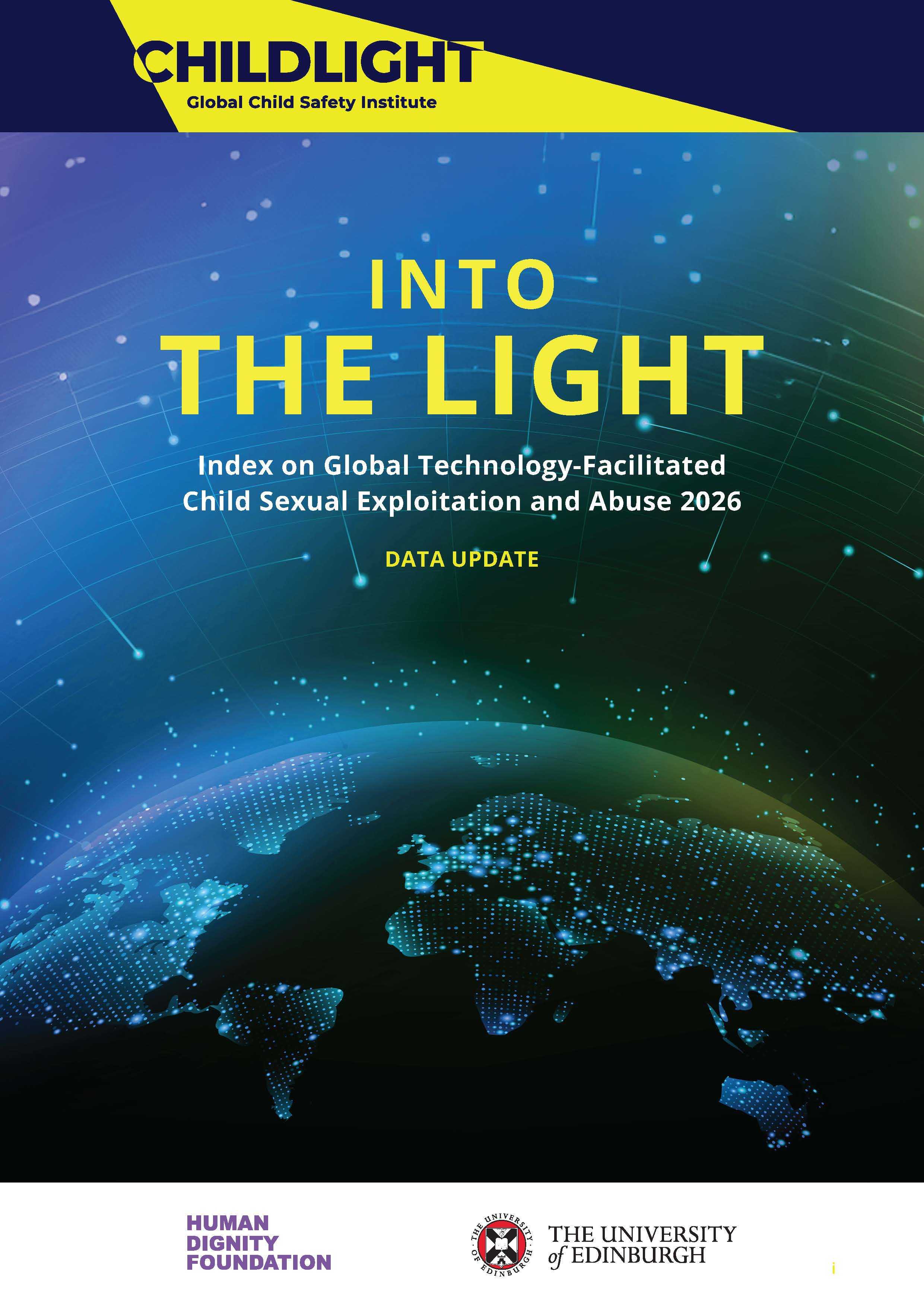
Cover of Into the Light 2026 Further Data Update report

At a glance

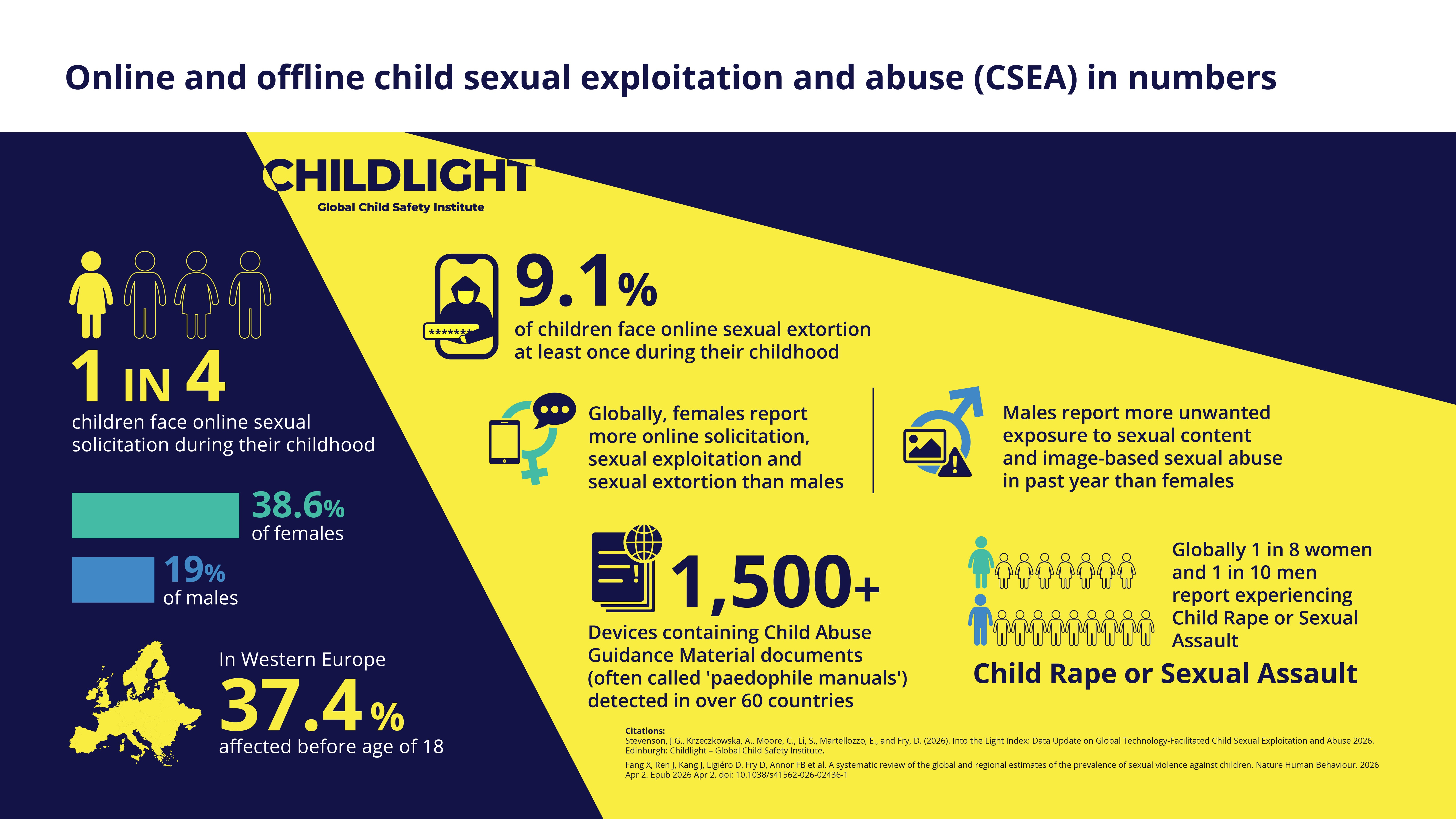
Infographic summarising key findings from Into the Light 2026 Further Data Update
Infographic: Online and offline child sexual exploitation and abuse (CSEA) in numbers. 1 in 4 children face online sexual solicitation during their childhood. 9.1% of children face online sexual extortion at least once during their childhood. Globally, females report more online solicitation, sexual exploitation and sexual extortion than males. Males report more unwanted exposure to sexual content and image-based sexual abuse in the past year than females. 38.6% of females and 19% of males report experiences of online sexual solicitation. In Western Europe, 37.4% of children are affected before the age of 18. Over 1,500 devices containing child abuse guidance material documents, often called 'paedophile manuals', have been detected in over 60 countries. Globally, 1 in 8 women and 1 in 10 men report experiencing child rape or sexual assault.

Foreword

Imagine in your community a classroom of 30 children. By the end of this year, two of them will experience sexual exploitation or abuse online. By the time they leave school as young adults, that number could rise to eight. Now, imagine that repeated in classrooms across the world, millions of times over.

This is not a thought experiment. Sadly, it is the reality revealed by new evidence in this report, which estimates that 27% of children are subjected to online solicitation with around 7% facing this in the past year alone. Furthermore, nearly one in ten can expect to face sexual extortion before turning 18. If a disease were harming children on this scale, it would already be recognised as a major global health crisis.

Statistics of this magnitude can feel abstract. But behind every number is a child: a young life disrupted, a sense of safety shattered, a future placed at risk. The harms of childhood sexual abuse are not fleeting. For many victims they include trauma, anxiety, depression and self-harm that can last long into adulthood. In the most severe cases the consequences are devastating, contributing to lifelong ill health and, tragically, to hundreds of thousands of premature deaths each year.

Viewed through a public health lens, the scale of the problem becomes unmistakable. Child sexual exploitation and abuse is one of the most powerful – and most overlooked – drivers of ill health across the life course. Evidence shows it contributes more to the burden of disease among girls and women than widely recognised risk factors such as smoking, harmful alcohol use or lack of physical activity. Among boys it is a greater contributor to ill health than poor diet. It is also more prevalent than many conditions that dominate public debate about children’s wellbeing, including childhood obesity, asthma and cancer.

Taken together, the evidence leads to a clear conclusion: child sexual exploitation and abuse is a worldwide health emergency. For too long it has been hiding in plain sight – fragmented across policy debates and treated primarily as a criminal justice issue. Law enforcement will always be essential, but the scale and persistence of the problem demand something more: a coordinated public health approach focused on prevention, with heath ministries playing a central, funded role as part of a multi-sectoral response.

The threat is also evolving. Technology has created extraordinary opportunities for children, yet it has opened new pathways for abuse. Criminal networks profit from the production and distribution of child sexual abuse material. Children are groomed online, manipulated and coerced into producing images of themselves, only to be blackmailed and exploited. Emerging technologies, including artificial intelligence, are accelerating the creation and spread of abuse material in ways that were unimaginable only a few years ago – and with help from so-called ‘paedophile manuals’ or ‘how to’ guides for perpetrators detected in more than 60 countries.

Yet this future is not inevitable. Imagine instead that same classroom where no child is subjected to sexual violence or exploitation. Where every young person is free to learn, grow and develop without fear. When children are safe, they are more likely to succeed at school, to flourish in work and to contribute positively to their communities. The benefits extend far beyond the classroom – strengthening health, prosperity and social stability for all.

This safer future, underpinned by the more complete data picture that we need globally on prevalence, drivers and solutions, is achievable. The evidence increasingly shows that prevention works, especially when embedded in maternal, child and adolescent health services – reaching children early, before harm occurs. Stronger regulation, effective education, smart legislation and technology designed with safety at its core can also help reduce and prevent harm. The question now is whether we have the collective resolve to act.

Portrait of Paul Stanfield
Signature of Paul Stanfield

Paul Stanfield

Chief Executive Officer

Childlight – Global Child Safety Institute

Executive summary

Overview View

Overview

Childlight is pleased to launch a new series of Into the Light Index data products: our data updates. These data updates provide an opportunity for us to delve deeper into emerging data, both qualitative and quantitative, that underpin our various Into the Light Index indicators around a specific thematic focus. This, our first, Into the Light Index data update focuses on new emerging data as well as updating existing global and regional prevalence and scale data on Technology-Facilitated Child Sexual Exploitation and Abuse (TF-CSEA). TF-CSEA refers to any form of child sexual abuse or exploitation in which digital technology plays a role, including the internet, smartphones, social media, messaging apps, gaming platforms or even devices used to record or store abuse.

This report includes an update on our living systematic review of TF-CSEA victimisation prevalence across our conceptual framework of five subtypes (online solicitation, exposure to unwanted sexual content, CSAM/IBSA, online sexual exploitation, sexual extortion) of victimisation experiences, our first update since first publishing this data in 2024. This data update also introduces new, emerging data sources on child sexual abuse material (CSAM) from index data partners and for the first time, a deeper analysis on CSEA guidance materials (also referred to as ‘paedophile manuals’ in some circles). This update on CSAM also includes new regional updates on our key indicators in this area.

This data update provides governments, civil society and other actors with the latest emerging evidence on TF-CSEA. Over the coming years, this data update approach will be expanded to other thematic areas, with our 2027 edition set to focus on a deeper dive into our set of system strengthening indicators.

This executive summary provides an overview of these findings, which are discussed in more detail in the full report. It can be read as a standalone document, or alongside our Interactive Index Dashboard, Technical Note and open access data for greater depth.

We hope that whatever your role, you find this Index data update a powerful tool to catalyse data-driven change – because children can’t wait.

Key findings View

Key findings

Prevalence of technology-facilitated child sexual exploitation and abuse (TF-CSEA)

Measuring TF-CSEA in representative surveys is a nascent but growing evidence base. We found an increase by 19 studies published between 1 October 2023 and 31 December 2024 using nationally or sub-nationally representative sampling that measure some form of TF-CSEA prevalence. The most frequently measured data is past year data on online solicitation, child sexual abuse material (CSAM)/ imagebased sexual abuse (IBSA) and exposure to unwanted sexual content with good country coverage across regions. Childhood lifetime estimates (experience before the age of 18) are less frequently measured than past year estimates likely due to the changing nature of technology across time. Online sexual exploitation and online sexual extortion are captured in far fewer representative surveys, suggesting a need to enhance ways and opportunities to measure these types of potential harms. Many included studies are starting to disaggregate by sex but do not include prevalence by perpetrator type.

The most frequently occurring type of TF-CSEA captured in surveys is online solicitation which was self-reported by 26.6% of participants that they had experienced at some point in their childhood. Online solicitation covers a range of unwanted or pressured sexual interactions, which may include casual sexual inquiries via mobile phone or the internet, or long-lasting sexual conversations that can lead to the exchange of sexual texts/pictures/videos or exposure of intimate body parts. All types of online solicitation may come from peers as well as adults. Online solicitation is defined broadly and diversely here, given the infancy of the field and the various kinds of questionnaire formulations that have been used. For example, some of the surveys specify that children received unwanted sexualised messages personalised for them, but others include encountering this type of messages that may have been directed at many respondents. It is important to note that majority of the surveys did not report perpetrator type, thus all different types of online solicitation may come from peers as well as adults. The diminished capacity to identify perpetrators in the online environment results in limited data on their characteristics. Incorporating follow-up questions on the child’s subjective perception of the perpetrators would allow more accurate identification and classifications of these unwanted behaviours. Once more consistent approaches to research and data collection are developed and more data are available on the impact of those behaviours, more granular and precise classifications will be possible. However, until then, the assemblage of different questionnaire items referring to this subtype of TF-CSEA identified in this research effort affords a basis for a more formal study of key definitional components.

There is an ongoing debate about how to best define online solicitation as a form of online sexual abuse and its consequences for epidemiology (Bulger et al., 2017; Finkelhor et al. 2024). Online solicitation is also increasingly illegal in national legislation and defined by major child protection bodies such as the Lanzarote Commission, UNICEF, ECPAT and Childlight as a form of TF-CSEA. In the absence of universal agreement about equating all forms of online sexual solicitation with child sexual abuse, due to variability in intent, context and harm, Childlight adopts a broader definition of TF-CESEA that includes unwanted sexual communication. This reflects emerging international frameworks and consistent evidence that such experiences can be harmful and may form part of pathways to more severe exploitation.

For past year experiences, we see unwanted exposure to sexual content (7.3%) and online solicitation (6.7%) reported by children in surveys. It is not surprising that these two types of abuse are most frequently reported as they encompass a range of potential harms, with varying protections in place for children depending on the country context.

For the smaller number of studies that disaggregate by sex, we see different types of TF-CSEA being reported by males and females. In existing representative data, we see that females report higher prevalence for online solicitation, online sexual exploitation and sexual extortion, including experiences both during childhood and in the past year. Whereas, males report more unwanted exposure to sexual content and CSAM/IBSA in the past year and more unwanted exposure to sexual content during their childhood compared to females.

There is variable coverage by UNICEF regions on the number of representative surveys exploring different subtypes. The more frequently measured subtypes include online solicitation, CSAM/IBSA and exposure to unwanted sexual content.

East and Southern Africa, Latin America and the Caribbean and Western Europe are regions that report higher prevalence of online solicitation (past year recall), while Eastern Europe and Central Asia and Western Europe show higher prevalence for past year exposure to unwanted sexual content. Regional variation in reported online sexual solicitation and unwanted sexual exposure likely reflects a combination of differences in children’s digital access, platform use and risk environments, rather than purely underlying differences in victimisation. For example, higher levels of unwanted sexual exposure in some regions may be associated with earlier and more widespread digital access, as well as platform ecologies characterised by high use of large-scale social media, videosharing, and image-based platforms, which increase the likelihood of encountering sexualised content. These patterns may also reflect higher disclosure rates and greater awareness of online risks, rather than exposure alone. However, there remains much to be understood about regional variation, including how technologyfacilitated child sexual exploitation and abuse is experienced, interpreted and captured in both child and retrospective adult survey data.

South Asia, West and Central Africa and Middle East and North Africa regions are lacking in representative survey data. This limits data insights on TF-CSEA to CSAM data only with two of these regions showing high CSAM volume and rates (see section Regional Analysis: The What, Where and How of CSAM data). However, more population-level measurement on victimisation experiences during childhood is needed to more fully understand and prevent TF-CSEA.

Scale and nature of child sexual abuse material (CSAM)

Child sexual abuse material data, collected from a few of the major CSAM tracking and analysis organisations globally, can provide insight into both the scale of its availability and the changes in its nature. By bringing the data generated and reported on from each organisation together it can help to provide the global picture of CSAM. Despite many limitations, the data continue to show that there is value in examining the similarities and differences between organisations, without which we would have less knowledge as to the perpetration and offending against children associated with CSAM availability.

CSAM rates, defined as the number of child sexual abuse images and videos per country proportionate to population size, remain high year-on-year in North America and Western Europe. The child sexual abuse material (CSAM) rate calculated by Childlight combines both hosting and reporting data and standardises these using total country population. Using total population, rather than child population alone accounts for CSAM involving broader systems and actors beyond children themselves. This is also a commonly considered factor in epidemiology, which, until we have stronger evidence of the multiple influences on CSAM availability, has been used to provide global comparability.

Using this approach, high-income regions such as North America and Western Europe show increasing CSAM rates relative to population, compared to declining trends in other regions. These patterns may reflect differences in technological access, detection capacity and reporting practices, but may also indicate a higher relative burden on public sector and regulatory systems.

Our report is one of the first studies to include new global data as well as frontline sector insights into CSEA Guidance Materials and the instructional, justifying and normative influencing nature of this content. These materials, commonly referred to as ‘paedophile manuals’, though more accurately described as child abuse guidance materials, are poorly defined in law and underexamined in research, despite their recognised role in offender behaviour and their inclusion in legislation in several jurisdictions. Global data specifically from peer-to-peer file sharing networks highlight that this material is circulating across at least 61 countries. In-depth discussion with experts in identifying and addressing this material highlights that these guidance materials are classified by their instructional nature, their justifications for legitimising CSEA and their creation of normative communities that perpetrate CSEA. It is important to note that these guidance materials can be used by children and adults against children, known or unknown; with experts highlighting that possession of this guidance material often coincides with possession of CSAM and/or contact offending against children suggesting this is an important area for policy and prevention consideration by countries.

Commercial CSAM tags show higher than average tags across the content hosted in the Eastern Europe and Central Asia region. Across 2023 and 2024, Eastern Europe and Central Asia exhibited consistently higher than average levels of tagged commercial CSAM (images/videos which are associated with commercial exploitation or trade), with 6.4% of all identified CSAM from one data source classified as commercial in 2023, decreasing to 2.5% in 2024. Beyond these elevated proportions, the region also recorded the highest absolute volume of commercial abusive content within the data, exceeding other regions by more than 1,000 images per year. Further research could explore this more to understand the underlying drivers of this finding and why it is hosted more often in this region.

There is an increase in the proportion of CSAM images and videos that is being tagged by analysts as ‘self-generated’ content. ‘Self-generated’ CSAM is a type of media showing individuals who have physical control of their recording device (i.e., selfies, self-recordings from their computers, etc.), which may have been shared directly or captured indirectly by other means. This can be created due to the grooming, deception or extortion of a child by an offender which can also be another child or an adult. It may also stem from a consensual correspondence between peers or coercive communication that becomes nonconsensual in its sharing or continued possession. Due to lack of agreement on preferred terminology, we have used single quotes throughout the document to note the limitations of this terminology.

Looking at one data source across several countries, we see an increase by 40-65% of ‘self-generated’ content that was tagged from 2023 to 2024. This highlights that this type of content is increasingly being recognised within content analysis, which is important. It also highlights the need for increasing access to report-and-remove type services such as Take It Down operated by the National Centre for Missing and Exploited Children (NCMEC), Report Remove operated by the Internet Watch Foundation (IWF) among others, which allows children and young people to report content they think is circulating online for removal.

We continue to see content tagged as AI-Generated or Virtual CSAM. From one new data source, we can see what is echoed in other data sources and that is the continued emergence of the virtual or AI-generated content. This is increasingly being tagged by analysts particularly in North America. As with other tagging data, it may be that those assessing the content are getting better at identifying and documenting the content as opposed to increases in exposure alone. But what we know is that analysts and those at the frontline are increasingly seeing this content which translates to a myriad of challenges and efforts to address this emerging type of content, including curating AI-CSAM specific hash sets, though this may not be sustainable given the high volume of CSAM AI can help produce.

Turning data to action View

Turning data to action

Childlight is, at its core, a data institute. However, our purpose extends beyond measurement alone. We are committed to using data as a tool for the safeguarding of children, ensuring that emerging evidence is not only documented but meaningfully translated into action.

Based on the evidence from this report, we are recommending the following actions:

1 Establish and enforce comprehensive national and regional legislative and regulatory frameworks that enable a population level approach to preventing TF-CSEA, with clear accountability and consequences for non-compliance

  • We ask that governments develop, implement and enforce national and regional legislative and regulatory frameworks that establish clear duties of care across relevant actors (including platforms and service providers), enable cross-sectoral coordinated responses and include proportionate but enforceable mechanisms for accountability and compliance. This draws on decades of public health experience in utilising regulation as a mechanism to enable population-level prevention, especially where industry is involved in health and well-being risks.
  • Childlight will focus on two main areas:
    1) supporting evidence-based legislative and regulatory development at global, regional and national levels, drawing on the best available data on the prevalence and nature of CSEA including TF-CSEA,
    2) committing to evaluating the implementation and outcomes of legislative and regulatory approaches, including their effectiveness in preventing harm, improving responses and strengthening child protection systems.

2 Support the legal basis for CSAM detection, removal of content and safeguarding of children

  • We ask that governments introduce and maintain a clear legal basis that permits and requires electronic service providers to detect CSAM on their platforms using appropriate technologies. Enable and mandate reporting pathways to law enforcement and relevant authorities, ensuring that detection leads to investigation, victim identification and perpetrator accountability. Ensure that legislative frameworks explicitly address impunity, recognising that the absence of a legal basis for detection and reporting limits enforcement and accountability which allows abuse to persist.
  • Childlight will continue to analyse and report on trends in CSAM data, tracking and reflecting changes in the CSAM landscape through our Into the Light Index on Global CSEA. Through our Childlight Technical Advisory Programme (C-TAP), we will support system strengthening efforts to address impunity as a key driver of CSEA.

3 Improve efforts for enhancing TF-CSEA data completeness and quality

  • We ask that every country fund and implement a representative victimisation survey, to fill existing data gaps. Specifically, we ask for greater data collection in the Middle East and North Africa, where there is very little CSEA victimisation data. This should include a common approach to typologies, methods and implementation to capture both in-person and technology-facilitated CSEA.
  • Childlight will support work to improve data standards, TF-CSEA conceptualisation and survey instrument refinement and design enhancing efforts already underway in the field and building on evidence from our Into the Light Index on Global CSEA.

4 Address legislative loopholes around AI-generated or virtual CSAM

  • We ask that governments and policy makers review their legislation to ensure it is appropriate to address the rising number of AI-generated and virtual CSAM reports so perpetrators cannot exploit loopholes and can be brought to justice.
  • Childlight will make methods and how to guides for conducting legislative review on AI related harms to children publicly available and continue supporting evidence-based reviews of this nature at country and regional levels.

5 Promote investment in national CSAM hotlines

  • We ask that countries and governments invest further into hotline analysis and capacity. We have seen that when hotlines are encouraged to conduct proactive detection and are supported, they can safeguard more children, which includes the discovery and removal of their sexual abuse content.
  • Childlight will continue to analyse CSAM hotline data and make results available via our Into the Light Index on Global CSEA.

6 Encourage more community and survivor-led online reporting tools

  • We ask that more online reporting portals for expedited image removal are developed globally to support children and youth in every region. Additionally, we encourage more platforms to work with services like Take it Down and Report Remove to support streamlined image based sexual abuse removal. The data show that services are increasingly being used over time, however are geographically limited to North America and Western Europe.
  • Childlight will continue to include data on report and remove type services within our Into the Light Global Index.

7 Address child abuse guidance materials within legislation and continue research into this area

  • We ask that the conceptual understanding presented by Childlight on ‘paedophile manuals’ is accepted. This means that frontline practitioners consider these files as a part of risk assessment of potential perpetrators and that policymakers ensure legislation covers the impermissibility of the creation, possession and dissemination of these files.
  • Childlight will continue to analyse existing qualitative and quantitative data and publish in this area.

Together, these actions allow us to move from evidence to real-world impact for children.

Further reading

Full Report

The complete data update report.

View report →

Technical Note

Further detail on methodology and data sources.

View technical note →

Related links

Out of the Shadows Index

While Childlight’s Into the Light index shows the scale of child sexual abuse and exploitation, the Out of the Shadows index assesses what countries are doing about it.

Measuring progress towards a world free of child sexual violence.

Visit site →
Back to top

If you have been affected by exploitation or abuse and need support, please visit